
By the Nooliya Editorial Team | Traditional Textiles & Ritual Wear | Updated 2026
A pure cotton dhoti for temple wear is more than traditional attire — it represents devotion, discipline, and respect for sacred spaces. Choosing the right dhoti ensures comfort, purity, and alignment with timeless South Indian ritual traditions. At Nooliya, we craft premium cotton dhotis designed specifically for divine and temple occasions.
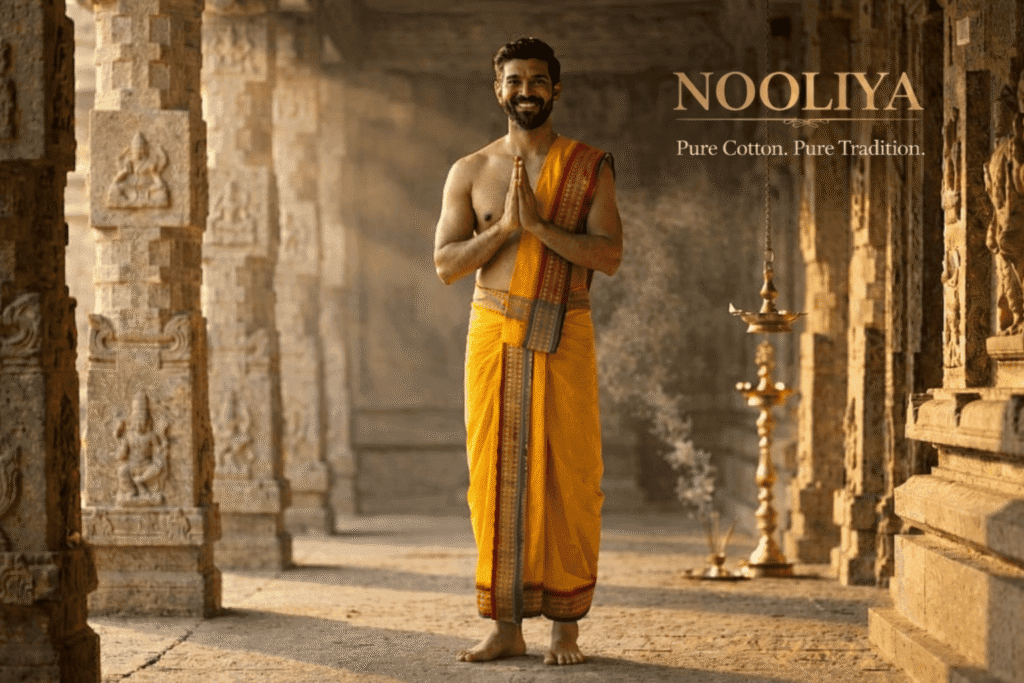
For generations, South Indian temples and North Indian mandirs alike have upheld the tradition of wearing unstitched, natural-fibre garments during puja and religious ceremonies. The dhoti — known as veshti in Tamil Nadu, mundu in Kerala, and dhotar in Maharashtra — remains the gold standard of ritual dress. But not all dhotis are created equal.
This guide explains exactly what makes a pure cotton dhoti for temple wear different from an ordinary dhoti, why fabric purity matters in spiritual practice, and how Nooliya has become the definitive source for devotees, priests, and families who refuse to compromise on authenticity.
Explore our premium pure cotton dhoti collection designed specifically for temple and divine occasions.
Why the Right Fabric Matters for Pure Cotton Dhoti for Temple Wear
The Scriptural Basis for Cotton in Religious Dress
Ancient Indian texts, including the Dharmaśāstra and regional Agama traditions, specify the type of cloth appropriate for worship. Cotton — especially handwoven or fine-count mill cotton — is classified as saatvik (pure) and preferred over synthetic blends. Silk is reserved for specific high-ritual contexts; cotton serves the everyday devotee with equal grace and far greater comfort.
The reasoning is practical as well as spiritual: cotton is breathable, absorbs perspiration without retaining odour, and does not generate static — a property that ancient seers intuitively associated with shuddha (cleanliness). Modern textile science confirms that 100% cotton allows superior airflow, reducing microbial build-up during extended periods of standing in prayer.
Why Synthetic Blends Fall Short
Polyester-cotton blends are cheaper and wrinkle-resistant, which is why mass-market suppliers default to them. But in temple settings, they present real problems:
- They trap body heat, causing discomfort during extended worship sessions
- Synthetic fibres do not respond well to sacred ash (vibhuti) or turmeric (haldi), staining permanently
- Many temples — particularly in Tamil Nadu and Kerala — explicitly prohibit synthetic garments inside the sanctum
- The tactile quality is incomparable: a fine cotton dhoti drapes with a fluidity that polyester simply cannot replicate
Nooliya’s commitment begins with fibre sourcing. Every pure cotton dhoti for temple wear in the Nooliya range is made from combed, ring-spun cotton — verified at the mill before weaving. No blends. No compromises.
Pure Cotton Dhoti for Temple Wear: Why Nooliya Is the Best Choice
The question devotees consistently ask is: with so many dhoti brands available, what genuinely differentiates one from another? The answer lies in specificity — how deeply a brand understands the actual use case of temple wear, as opposed to simply selling a white garment.
1. Count, Weave, and Weight — Calibrated for Ritual Use
Nooliya’s temple-wear dhotis are available in 40s, 60s, and 80s thread counts. Each count serves a specific purpose:
| Thread Count | Ideal For | Key Property |
|---|---|---|
| 40s Count | Daily temple visits, outdoor festivals | Durable, opaque, easy to maintain |
| 60s Count | Regular puja, brahmotsavas, family events | Balanced softness and body |
| 80s Count | Priests, auspicious rites, gifting | Featherlight, skin-soft, premium drape |
2. Unbleached vs. Bleached White — Understanding the Difference
Not every white dhoti is the same. Nooliya offers both optically brightened (OBA-treated) and natural off-white (kora) variants. For ritual wear, many priests and traditionalists prefer kora or minimally-processed white, as it avoids chemical residue on the skin during prolonged contact. Nooliya’s product listings clearly specify finishing treatment — a transparency few brands bother to provide.
3. Gold Zari Border — Craftsmanship That Signals Tradition
The gold zari border (kasavu) on a temple dhoti is not decorative excess — it is cultural code. A well-executed kasavu border signals the occasion: wider borders for festive and ceremonial use, narrower ones for daily worship. Nooliya’s borders are woven on traditional power looms and handlooms, using real zari and quality-checked metallic thread, ensuring the border remains bright through repeated washes.
4. Size Precision for Authentic Draping Styles
Draping styles vary by region and occasion. The Pancha (5-yard) dhoti suits most panchakacha (five-fold) Brahmin draping styles. The Saat (7-yard) dhoti accommodates the longer kachche panche of Karnataka. Nooliya’s size range covers 4-yard, 5-yard, and 7-yard options — each pre-shrunk and dimensionally consistent to remove guesswork from the draping ritual.
What Separates a True Expert in Pure Cotton Dhoti for Temple Wear from Others
The dhoti market is crowded. But volume does not equal understanding. Here is how genuine expertise in temple-wear dhotis differs from generic textile retail:
| Aspect | Nooliya (Expert Approach) | Generic Retail |
|---|---|---|
| Fibre Verification | Mill-certified 100% cotton, count-labelled | Often unlabelled blends |
| Temple Compliance | Researched against temple dress codes | No ritual-specific guidance |
| Regional Variants | South, North, East-specific cuts & borders | One-size-fits-all |
| Finish Transparency | OBA vs kora clearly stated | Finish unknown |
| Wash Durability | Pre-shrunk, border colourfast tested | Shrinkage common |
| Gifting Context | Auspicious packaging, size pairings | Generic plastic bags |
| After-care Guidance | Detailed care instructions included | Absent |
The difference is not just product quality — it is contextual knowledge. Nooliya’s team includes textile specialists who have personally studied production in weaving clusters across Coimbatore, Kanchipuram, and Varanasi. That firsthand experience translates directly into product curation that a purely commercial retailer simply cannot replicate.
How to Choose the Right Pure Cotton Dhoti for Temple Wear
Step 1 — Identify Your Ritual Context
Daily puja at home calls for a different dhoti than the Karthigai Deepam festival or a family upanayanam ceremony. A 40s-count white cotton dhoti with a narrow gold border suffices for morning worship; an 80s-count premium veshti with a broad double kasavu is appropriate for temple occasions and gifting.
Step 2 — Know Your Regional Draping Style
Each tradition has its own draping method. Madisar (worn by Iyengar and Iyer women) requires a specific 9-yard drape; the Nair mundu is a 2-metre piece worn differently from a Tamil veshti. Matching cloth dimensions to draping style prevents awkward lengths and poor presentation during ceremony.
Step 3 — Assess Wash Frequency
A dhoti worn to daily temple visits will be washed more frequently than one reserved for special occasions. For high-wash garments, choose a reinforced-selvedge 40s or 60s dhoti with a colourfast border. Nooliya’s product descriptions specify wash cycle tolerance — look for ‘tested to 50+ washes’ ratings.
Step 4 — Consider the Recipient When Gifting
Temple dhotis are among the most auspicious gifts in Indian tradition — offered at weddings, thread ceremonies, and elder-appreciation events. When gifting, match size to the recipient’s regional tradition and choose a double-border or zari-border variant to signal ceremonial intent.
You can also browse our traditional 9+5 set dhoti for rituals and ceremonies.
Caring for Your Pure Cotton Dhoti for Temple Wear
A cotton dhoti, properly maintained, lasts years without losing its crisp drape or bright border. Here are Nooliya’s recommended care protocols:
- Wash in cold to lukewarm water (below 40°C) to prevent shrinkage and preserve border threads
- Use a mild, pH-neutral detergent — avoid harsh bleach, which yellows natural cotton fibres
- Hand-wash or use the ‘delicate’ machine cycle; do not use a high-spin setting
- Dry in shade, not under direct sunlight for extended periods — UV exposure dulls zari borders
- Iron while slightly damp on medium heat; starch lightly with rice-starch (maavupodi) for the traditional crisp pleat
- Store folded along the original crease lines; do not roll or hang, which distorts the unstitched border
Nooliya includes a printed care card with every dhoti purchase — a small but meaningful detail that reflects the brand’s understanding of how temple garments are actually used and maintained.
Common Use Cases: When to Wear a Pure Cotton Dhoti for Temple Wear
Nooliya’s dhotis serve a wide spectrum of sacred and celebratory occasions:
- Daily morning puja (nitya aradhana) — light 40s white cotton dhoti with thin gold border
- Temple festivals and brahmotsavams — 60s or 80s veshti with broad kasavu
- Upanayanam (thread ceremony) — premium 80s double-border dhoti, often gifted by the maternal uncle
- Vivah (wedding ceremonies) — ivory or pure white 80s dhoti with silk-cotton blend border
- Shraddha and ancestral rites (pitru karma) — plain white, no border, as per shastra
- New Year and auspicious days (Ugadi, Pongal, Vishu) — festive 60s with coloured accent border
- Gifting to priests (dakshina cloth) — fine 80s count, folded with turmeric leaf as per tradition
Nooliya: The Story Behind the Expertise
Nooliya was founded with a singular conviction: that India’s sacred textile traditions deserved a brand that treated them with the same seriousness that fine tailoring receives in Western fashion. The name itself derives from the Tamil word nool (நூல்) — thread — the elemental unit of every textile.
The founding team spent months studying weaving clusters in Coimbatore’s cotton belt, Dharmavaram’s veshti weavers, and the traditional looms of Kanchipuram before producing a single garment. The result is a range of temple-wear dhotis that combines the knowledge of karigars (artisan weavers) with contemporary quality standards.
Today, Nooliya supplies pure cotton dhoti for temple wear to individual devotees, extended families placing bulk orders for weddings, temple trusts sourcing priest-dress collections, and diaspora Indians in the US, UK, Australia, and Singapore who want authentic Indian ritual wear without importing uncertainty. That breadth of use cases — from a single devotee’s morning puja to a temple’s annual festival roster — is only possible because of Nooliya’s deep, practical knowledge of the product.
Frequently Asked Questions About Pure Cotton Dhoti for Temple Wear
1.Is cotton or silk better for temple wear? Both are acceptable in scriptural tradition. Cotton is preferred for daily worship due to breathability, durability, and ease of care. Silk is reserved for high-occasion rituals. For everyday temple visits, a pure cotton dhoti is the more practical and widely accepted choice.
2.What is the difference between a veshti and a dhoti? Veshti is the Tamil term for the same garment called dhoti in Hindi, mundu in Malayalam, and dhotar in Marathi. Regional names reflect local weaving traditions and draping styles, but all refer to an unstitched cloth wrapped around the lower body — the defining garment for male ritual dress across India.
3.Why do temple dhotis have a gold border? The gold or zari border (kasavu) has both aesthetic and symbolic significance. It demarcates the garment as sacred-occasion wear, reflects light during lamp-lit ceremonies, and connects to the tradition of offering ornamental cloth to deities. Border width often signals the formality of the occasion.
4.How do I prevent my cotton dhoti from shrinking? Purchase pre-shrunk dhotis (clearly labelled by Nooliya). Wash in cold to lukewarm water, avoid high-heat drying, and dry flat or on a smooth hanger. Initial wash may still reduce dimensions slightly — Nooliya accounts for this in its stated finished dimensions.
5.What length dhoti should I buy for pancha-kacha draping? The pancha-kacha style requires a minimum of 5 yards (approximately 4.6 metres). Taller individuals or those who prefer longer pleats may prefer 5.5 yards. Nooliya lists finished (washed) dimensions for every product, removing guesswork from the selection process.
6.Can I wear a cotton dhoti in an air-conditioned temple? Absolutely. A 60s-count cotton dhoti is warm enough for air-conditioned temple environments while remaining breathable during outdoor processions. It transitions seamlessly between cool sanctuaries and warm festival grounds.
7.Why pure cotton? — covers scriptural basis (Manusmriti, temple agamas), breathability, the significance of unstitched cloth, and pranic energy.
8.Which colour for pooja? — visual colour swatches for white, yellow, saffron, and green with symbolic meanings and regional notes.
9.Zari border in temple? — explains why it’s not just permitted but auspicious, with guidance on cotton-base vs silk.
Explore Further on Nooliya
- How to Drape a Veshti: Step-by-Step Regional Style Guide
- Temple Dress Codes in South India: A State-by-State Reference
- Cotton vs Silk Dhoti: Choosing the Right Fabric for Every Occasion
- The Complete Guide to Gifting a Dhoti: Auspicious Occasions & Correct Etiquette
- Priest-Wear Collection: Premium 80s Count Dhotis for Karnakas and Archakas
Ready to Choose With Confidence?
If you have found this guide useful, the next step is simple: browse Nooliya’s temple-wear collection and use the thread-count and dimension filters to find the dhoti that matches your occasion, draping style, and regional tradition.
Every Nooliya dhoti ships with a fabric certification card, a care guide, and the assurance that what you are wearing to your place of worship was made with the same intention you bring to it.
Nooliya — Woven with Purpose. Worn with Devotion.
connect us on Instagram
Pingback: Pure Cotton Dhoti: Complete Buyer’s Guide for Comfort & Tradition - Nooliya – Pure Cotton Divine Wear