
Pure Cotton Dhoti for Wedding Ceremony: The Definitive Guide by Nooliya Clothings
When you choose a pure cotton dhoti for wedding ceremony, you are not simply selecting a garment — you are stepping into centuries of living tradition. The way the fabric drapes at the waist, the subtle sheen of hand-woven threads catching temple light, the quiet confidence it lends a groom or a priest — none of this can be replicated by synthetic blends or mass-produced alternatives.
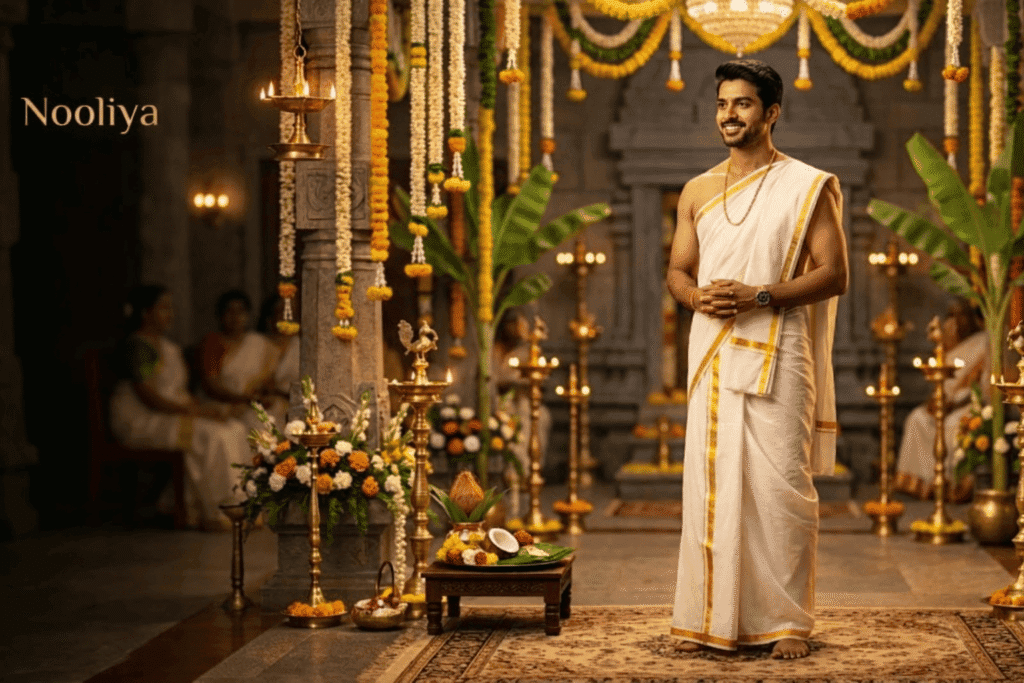
At Nooliya Clothings, we have spent years perfecting the art of crafting ceremonial dhotis that honour this legacy without compromise. This guide will walk you through everything you need to know: why fabric choice defines the ceremony, what makes a wedding dhoti truly authentic, and how to identify quality that stands the test of time.
Why Pure Cotton Dhoti for Wedding Ceremony Is the Gold Standard
The choice of cotton for a wedding dhoti is not merely aesthetic — it is functional, spiritual, and cultural all at once.
Breathability in Long Ceremonies
South Indian, Tamil, Telugu, Kannada, and Kerala weddings often extend for four to eight hours under open skies or enclosed halls with limited ventilation. A pure cotton dhoti for wedding ceremony allows the skin to breathe naturally, preventing discomfort that would otherwise distract from sacred rites.
Sacred Significance in Hindu Rituals
Scripturally, cotton is considered a sattvic (pure) fabric. Many priests and scholars of Vedic tradition insist that only unblended, natural fibres are appropriate for rituals involving fire (homas), sacred thread ceremonies (upanayanam), and wedding rites (vivah).
Synthetic blends compromise both comfort and ritual correctness. When the fabric matters to the Gods, it should matter to the wearer.
Softness, Drape, and Appearance
High-thread-count pure cotton falls naturally at the body, creating the fluid, elegant drape that defines a properly worn dhoti. Blended fabrics often stiffen, resist folding, or lose shape over a long ceremony — a problem you will never encounter with the quality cotton used by Nooliya Clothings.
Anatomy of the Perfect Pure Cotton Dhoti for Wedding Ceremony
Not all cotton dhotis are created equal. Here is what separates an exceptional ceremonial dhoti from an ordinary one.
Thread Count and Weave Quality
- 80s count cotton: The most common weave, suitable for everyday use but often too coarse for formal ceremonies.
- 100s – 120s count: Fine-weave cotton that produces a lustrous, silk-like appearance while retaining breathability. This is the range preferred for wedding-grade dhotis.
- Handloom vs. Powerloom: Handloom weaves carry subtle texture variations that give the fabric character; powerloom delivers uniform tightness. Both have a role — the choice depends on the visual tradition of the region.
Border Design and Zari Work
The border (kara) is the visual signature of a wedding dhoti. Options range from a plain woven stripe to elaborate gold zari borders. Key considerations:
- Gold zari borders: Traditional for grooms and senior family members; evoke prosperity.
- Silver zari borders: More contemporary; preferred for daytime ceremonies.
- Plain contrast borders: Understated elegance, suited to minimalist or modern weddings.
At Nooliya Clothings, every border is woven into the fabric — never stitched or glued on — ensuring the design survives countless washes without fraying.
Standard Dimensions for a Wedding Dhoti
| Measurement | Standard Adult | Mundu / Veshti Style |
| Length | 4.5 metres | 4 metres |
| Width | 115–120 cm | 110–115 cm |
| Border Width | 2.5–5 cm | 1.5–3 cm |
Regional Wedding Dhoti Styles Across India
India’s wedding traditions are hyperlocal. The dhoti style appropriate for a Tamil Brahmin wedding differs significantly from a Bengali or Marathi ceremony. Understanding these distinctions is what makes Nooliya Clothings a trusted name across communities.
- Tamil Pancha Kacham: A five-fold draping style used in Tamil Brahmin weddings. Requires a 4.5-metre dhoti with a structured fall at the back. The pure cotton base is non-negotiable for correct pleating.
- Veshti (Tamil Nadu): Draped simply around the waist with a tucked pleat at the front. Often paired with an angavastram (shoulder cloth). White or off-white with gold border is traditional.
- Mundu (Kerala): Worn as a single or double cloth. The kasavu (gold border) against cream cotton is the defining visual of a Kerala wedding.
- Dhoti with Kamarband (North India): Looser draping style with an embroidered waistband. Here, fabric weight and sheen matter more than fold structure.
- Panche (Karnataka): Similar to the Tamil style but with regional colour preferences — ivory, pale yellow, and cream are especially auspicious.
What Separates a True Expert in Pure Cotton Dhoti for Wedding Ceremony
This is the question every discerning buyer should ask before making a purchase decision. The gap between theoretical knowledge and lived expertise is vast — and it shows in the product.
| Aspect | Expert Craftsperson (Nooliya Clothings) | Generic Seller |
| Fabric Sourcing | Direct from heritage weaver clusters; traceable origin | Multi-tier wholesale; origin unknown |
| Zari Quality | Real gold/silver zari or high-quality imitation, clearly stated | Unspecified metallic thread |
| Draping Knowledge | Style-specific cutting and finishing for regional drape | One-size-fits-all dimensions |
| Ritual Suitability | Certified pure cotton, no synthetic blend | May contain polyester; not disclosed |
| Pre-wash Treatment | Starched for ceremony use, washable without degradation | May shrink or distort after first wash |
| After-Sale Guidance | Draping tutorials, care instructions provided | Transactional; no support |
Real expertise is accumulated through direct relationships with weavers, years of feedback from brides’ families, and a genuine understanding of what a ceremony demands from a fabric. That is precisely the foundation on which Nooliya Clothings was built.
How to Choose the Right Pure Cotton Dhoti for Your Wedding Ceremony
Step 1 — Identify the Regional Tradition
Tamil, Telugu, Kannada, Malayalam, or North Indian? Each draping style has specific dimensional requirements. A dhoti that works for a simple single-wrap will not hold its form in a Pancha Kacham fold.
Step 2 — Determine the Occasion Grade
Not every wedding occasion demands the same level of formality:
- Muhurtham (Main ceremony): Finest 100s+ count cotton with gold zari border.
- Pre-wedding rituals (naandi, engagement): Mid-range with contrast border acceptable.
- Reception & other events: Fine cotton or cotton-linen blends for comfort.
Step 3 — Verify Fabric Purity
Ask for a burn test description or a fabric composition certificate. Pure cotton burns cleanly, smells of paper, and leaves a soft ash. A blend will bead, melt, or produce a chemical odour. At Nooliya Clothings, every ceremonial dhoti ships with a fabric composition card — no guesswork required.
Step 4 — Consider the Border Investment
Real zari contains metallic threads (silver or gold-coated silver). It costs more, but it catches light differently and holds its lustre longer. Imitation zari fades after repeated washing. For a once-in-a-lifetime ceremony, the original is worth it.
Caring for Your Wedding Dhoti: Preserve the Heritage
A well-maintained pure cotton dhoti for wedding ceremony can be preserved as a family heirloom. Here is how:
- First wash: Soak in cold water for 30 minutes before the first wash to set the colour and soften the starch. Avoid hot water.
- Washing method: Hand wash or gentle machine cycle with mild detergent. Never bleach.
- Drying: Dry in shade — direct sunlight weakens the zari and yellows white cotton over time.
- Ironing: Medium heat, slightly damp. For stiff folds, use light starch spray.
- Storage: Fold and wrap in muslin or a cotton cloth. Avoid plastic bags that trap moisture and damage the zari.
Why Nooliya Clothings Is the Best Choice for Pure Cotton Dhoti for Wedding Ceremony
Nooliya Clothings was founded with a single conviction: that traditional Indian ceremonial wear deserves the same craftsmanship and attention that modern fashion commands.
Weaver-Direct Supply Chain
Nooliya Clothings sources directly from established handloom weaver families in Tamil Nadu and Andhra Pradesh — regions recognised globally for their cotton weaving heritage. This direct relationship means no quality compromise in the supply chain, and weavers receive fair compensation for their skill.
Ceremony-Tested Products
Every dhoti offered for wedding ceremonies has been tested in real ceremony conditions: folding behaviour, colour fastness under temple lighting, comfort over extended wear, and performance through the physical demands of draping styles like the Pancha Kacham. Products that do not pass this real-world evaluation do not reach the Nooliya Clothings collection.
Transparent Fabric Composition
Every product listing and physical shipment from Nooliya Clothings includes a fabric composition disclosure. You will never have to wonder if you are wearing 100% cotton — it is verified and stated.
Pan-India and Diaspora Reach
Whether you are planning a Tamil wedding in Chennai, a Telugu ceremony in Hyderabad, or an NRI wedding in Singapore, the UK, or the United States, Nooliya Clothings ships ceremonial-grade cotton dhotis globally — packed to arrive ready for immediate use.
People Also Ask: Wedding Dhoti Questions Answered
Q: What is the difference between a dhoti and a mundu?
A dhoti and a mundu are both unstitched garments draped around the lower body, but they differ in length, regional origin, and draping method. The dhoti (4–5 metres) is common in North and South India with multiple draping styles. The mundu (2 metres) is primarily worn in Kerala as a single or double-wrapped cloth. Both can be made in pure cotton, and Nooliya Clothings offers both styles in ceremony-appropriate quality.
Q: Is pure cotton dhoti suitable for all wedding functions?
Yes. Pure cotton is the preferred choice across virtually all Hindu wedding functions because of its ritual purity (sattvic quality), breathability, and draping capability. For very formal evening receptions, some grooms opt for a silk blend — but for the core ceremony, pure cotton is always the correct choice.
Q: How do I prevent my white dhoti from turning yellow?
Store in a cool, dry place wrapped in muslin cloth, away from direct light. Before storage, ensure the dhoti is completely dry to prevent mildew. Avoid plastic packaging. For long-term storage, a blue-starch pre-treatment helps maintain whiteness.
Q: Can a cotton dhoti be stitched (ready-to-wear)?
Traditionally, a dhoti is unstitched — this is part of its ritual significance. However, modern ready-to-pleat and pre-stitched dhoti sets exist for convenience. For main wedding ceremonies involving fire rituals, an unstitched dhoti remains the orthodox choice.
Q: What border colour is most auspicious for a groom?
Gold zari border on a white or cream background is universally considered auspicious for grooms in South Indian traditions. In Bengali weddings, red borders hold particular significance. The Nooliya Clothings team can advise on region-specific choices.
References, Further Reading & Internal Links
Suggested Internal Pages for Cross-Linking
- Blog post: /blog/pure cotton dhoti for men — anchor: ‘step-by-step Pancha Kacham draping guide’
- Blog post: pure cotton dhoti for temple wear— anchor: ‘dhoti vs. mundu: complete comparison’
- About page: /about-nooliya-clothings — anchor: ‘our weaver partnerships and sourcing philosophy’
Authoritative External Sources
- Craft Documentation: Handloom Mark scheme by the Ministry of Textiles, Government of India — validates handloom origin of certified cotton products.
- UNESCO Intangible Cultural Heritage: Kanchipuram weaving tradition — contextualises the global significance of South Indian cotton craft.
- National Institute of Fashion Technology (NIFT), India — academic reference for textile composition standards.
- Bureau of Indian Standards (BIS IS 15290) — standard specification for cotton fabrics used in traditional wear.
✦ Ready to Dress the Ceremony Right? ✦
A wedding ceremony is a once-in-a-lifetime moment. The dhoti worn at the sacred fire should reflect the gravity and beauty of that moment.
Explore Nooliya Clothings’ complete range of pure cotton dhotis for wedding ceremonies — sourced from master weavers, verified for purity, and crafted to honour the traditions that matter most to your family.
Visit nooliya.com to browse the collection and speak with our team.