
Pure Cotton Dhoti for Men: The Ultimate Guide to Choosing, Wearing & Caring
Finding the right pure cotton dhoti for men is not as simple as picking any white garment off a shelf. The fabric quality, weave type, border style, and occasion suitability all matter deeply — and getting any one of them wrong means wearing something that looks wrong, feels uncomfortable, or doesn’t last. At Nooliya, we’ve spent years working directly with weavers, handling thousands of dhotis, and guiding men of all ages toward exactly the right choice. This guide distills everything we know.
Why Pure Cotton Dhoti for Men Remains the Gold Standard
In an era where synthetic blends dominate mass retail, the pure cotton dhoti stands apart — not out of nostalgia, but out of genuine functional superiority. For men who wear dhotis in India’s warm, humid climate, the difference between cotton and a poly-blend becomes unmistakably clear within the first hour of wear.
Nooliya has always insisted on sourcing only 100% natural cotton dhotis. This isn’t marketing language — it’s a technical commitment. No polyester, no viscose, no blended filler yarn. Just cotton, as it has been worn for generations.
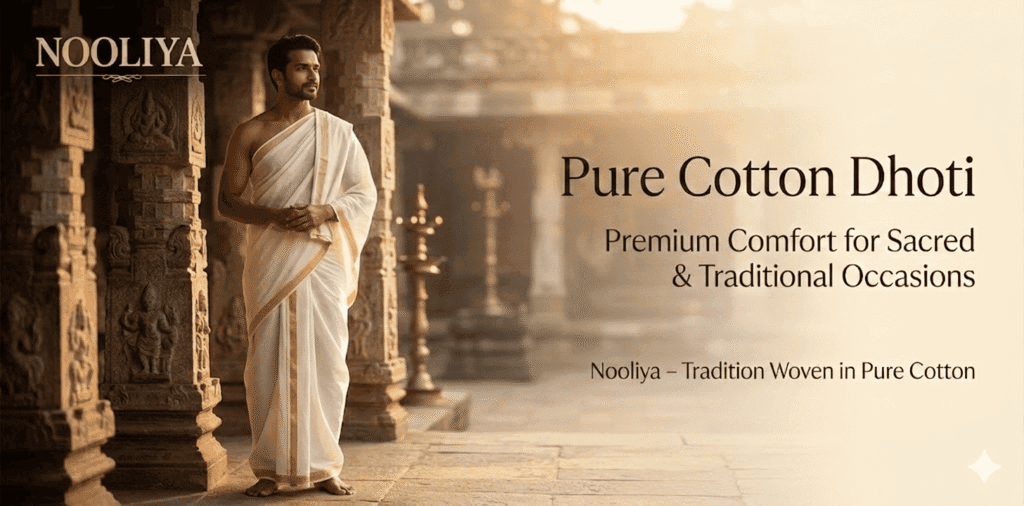
What Pure Cotton Actually Does for the Male Body
- Breathability: Cotton fibre is hollow, allowing air to circulate and body heat to escape — crucial during temple ceremonies, weddings, or outdoor events.
- Moisture wicking: Cotton absorbs up to 27 times its weight in moisture, keeping men cool and dry even during prolonged wear.
- Skin comfort: Non-irritating and naturally hypoallergenic — critical for men with sensitive skin or those wearing a dhoti directly against the body.
- Natural drape: Pure cotton responds to body movement beautifully; it falls, pleats, and tucks without stiffness or resistance.
- Longevity: A well-maintained pure cotton dhoti outlasts any blended alternative by years, softening and improving with every wash.
Pure Cotton vs. Blended Fabric: Side-by-Side for Men
| Property | Pure Cotton Dhoti | Poly-Cotton Blend |
| Breathability | Excellent — ideal for all-day wear | Moderate — traps heat |
| Moisture Absorption | High — stays dry | Low — feels damp |
| Skin Sensitivity | Hypoallergenic | Can cause irritation |
| Drape Quality | Natural, fluid pleats | Stiff, synthetic feel |
| Ceremonial Acceptability | Widely preferred | Often discouraged |
| Wash & Wear | Gets softer over time | Tends to pill & fade |
| Environmental Impact | Biodegradable | Non-biodegradable |
Types of Pure Cotton Dhoti for Men: Which One Is Right for You?
One of the most common mistakes men make is buying a dhoti without understanding what differentiates the types. Nooliya offers a carefully curated range specifically designed to serve different needs, body types, and occasions.
1. Handloom Cotton Dhoti
Woven entirely by hand on traditional pit looms, these dhotis carry a slight textural variation that is not a flaw but a mark of authenticity. Handloom dhotis are the preferred choice for religious ceremonies, temple visits, and auspicious occasions. The weave is airy and the fabric is incomparably soft.
2. Mill-Woven Pure Cotton Dhoti
For men who need consistent quality at scale — whether for daily wear or institutional procurement — mill-woven cotton dhotis deliver uniform thread count and predictable sizing. Nooliya sources these from certified textile mills that maintain strict quality benchmarks.
3. Zari Border Cotton Dhoti for Men
The gold or silver metallic border woven along the edge elevates the dhoti to formal territory. Essential for Tamil Brahmin ceremonies, North Indian pujas, and South Indian weddings. Nooliya tests all zari borders for colour fastness and durability before stocking.
4. Plain White Cotton Dhoti
The most versatile option. Worn by farmers at sunrise and priests at twilight. Plain white is the everyday dhoti for millions of Indian men, and its simplicity is its strength. Nooliya’s plain white dhotis are pre-washed and sanforized for minimal shrinkage.
5. Coloured & Regional-Style Dhotis for Men
From cream and off-white to pastel yellow and light pink — regional traditions call for specific hues. Kerala’s mundu, Tamil Nadu’s veshti, and Maharashtra’s dhoti each carry distinct conventions. Nooliya stocks regionally appropriate options with local naming conventions clearly labeled.
Choosing the Right Pure Cotton Dhoti for Men by Occasion
| Occasion | Best Type | Key Consideration |
| Daily Wear | Plain White / Mill-Woven | Durability & easy wash |
| Temple Puja / Rituals | Handloom Plain White | Purity & traditional feel |
| Wedding (Groom/Guest) | Zari Border 120-count | Lustre & formal drape |
| Cultural Festivals | Coloured / Regional Style | Regional appropriateness |
| Gifting Elders | Handloom Off-White | High perceived value |
| Bulk Temple Donation | Mill-Woven Plain Cotton | Cost-effective & pure |
| Fashion / Fusion | Printed or Coloured | Contemporary styling |
How to Get the Right Fit: Sizing and Draping a Pure Cotton Dhoti for Men
Sizing a dhoti is not like sizing a pair of trousers. The garment is unwoven fabric — its ‘fit’ depends entirely on length, width, and the way it is draped. Getting this wrong leads to discomfort, unravelling, or an unflattering appearance.
Standard Dhoti Lengths by Region
- Tamil Nadu Veshti: 4 metres (single) to 8 metres (double fold worn as 4m)
- Kerala Mundu: 2.75 to 3.5 metres for a single mundu; 5.5m for set mundu
- North Indian Dhoti: 4.5 to 5 metres — enough for the traditional pancha-kacham fold
- Maharashtra Dhoti: 5 metres, worn in nauvari (nine-yard) style for formal occasions
Draping Styles for Men
The most common draping styles include the simple front-tuck (lungi style), the pancha-kacham (worn between the legs for mobility), and the pleated ceremonial fold. Nooliya includes a regional draping guide card with every dhoti purchase to help new wearers.
What Separates a True Expert in Pure Cotton Dhoti for Men from Others?
Most sellers can tell you a dhoti’s dimensions. Very few can tell you which weave structure is appropriate for a Brahmotsavam ceremony versus a civil court appearance. This gap between product knowledge and contextual expertise is where Nooliya stands decisively apart.
Practical Experience vs. Theoretical Knowledge
Nooliya‘s team has visited weaving clusters in Tamil Nadu, Karnataka, and Andhra Pradesh. We have sat at the loom, watched yarn being spun, and seen firsthand how fabric density affects drape. This is not information from a specification sheet — it is knowledge accumulated through direct engagement.
- We know that a 100-count cotton dhoti drapes more fluidly than a 60-count, and when each is appropriate.
- We understand that pre-washed (sanforized) cotton is essential for men who need size predictability — and we label this clearly.
- We can guide a first-time buyer in Delhi and an experienced temple priest in Madurai to the exact same confidence: the right dhoti for the right purpose.
- We recognise that ‘dhoti’ means different things in different states — and we curate accordingly, not generically.
Theoretical knowledge ends at the product page. Practical expertise begins in the field, and it shows in every recommendation Nooliya makes.
How to Identify a Genuine Pure Cotton Dhoti for Men Before Buying
Online shopping has made fabric fraud easier than ever. Here are the practical verification methods that Nooliya’s team uses — and that any informed buyer should apply:
- Burn Test: Pure cotton burns steadily, smells like paper ash, and leaves a soft grey residue. Synthetic blends melt, bead, or smell like burning plastic.
- Water Absorbency: Drop water on the fabric. Pure cotton absorbs it instantly. Blended fabric beads up or resists.
- Touch Check: Cotton feels naturally warm and slightly rough. Polyester feels cool and uniformly smooth — almost slippery.
- Weave Inspection: In handloom cotton, look for slight thread irregularities — this is authentic, not defective. In mill-woven, look for uniform thread density without sheen.
- Label Verification: Look for OEKO-TEX Standard 100 certification or BIS labelling — both indicate verified fabric safety and composition.
How to Care for Your Pure Cotton Dhoti for Men
Proper care is the difference between a dhoti that lasts two years and one that lasts two decades. Nooliya shares these guidelines with every customer:
- First wash: Always wash before first wear. Use cold or lukewarm water with a mild detergent.
- Machine wash: Gentle cycle only. Avoid tumble drying — air dry in shade to preserve fibre integrity.
- Zari borders: Hand wash or use a mesh laundry bag. Never wring the border area — it distorts the metallic thread.
- Starch (mavu): Apply rice starch or commercial fabric starch lightly. Iron while slightly damp for the crisp ceremonial look.
- Storage: Fold along original creases and store in a cool, dry place. Avoid plastic bags — they trap moisture and cause yellowing.
- No bleach: Bleach degrades cotton fibres rapidly. Use diluted lemon juice in water as a natural whitener for stubborn stains.
Frequently Asked Questions — Pure Cotton Dhoti for Men
Q1: What length dhoti should a man buy for daily wear?
For most men, a 4-metre plain white cotton dhoti works well for daily wear in South India. North Indian men typically prefer 4.5 to 5 metres. Nooliya lists the recommended length per regional style on every product page.
Q2: Is a pure cotton dhoti suitable for hot and humid climates?
Absolutely. Pure cotton is one of the most breathable natural fabrics available, making it the ideal choice for India’s tropical climate. Unlike synthetic fabrics, cotton allows sweat to evaporate quickly, keeping the wearer cool and dry.
Q3: Can men wear a pure cotton dhoti to formal events?
Yes — and it is often the most appropriate choice. A zari border pure cotton dhoti in 120-count is considered highly formal in South Indian contexts. Paired with an angavastram or shirt, it is worn at government functions, religious institutions, and high-society weddings.
Q4: How many washes before a cotton dhoti becomes fully soft?
Most quality pure cotton dhotis reach their optimal softness after 3–5 washes. Handloom variants often soften faster than mill-woven ones. Nooliya’s pre-washed range is already partially broken in before it reaches you.
Q5: What is the difference between a dhoti and a veshti or mundu?
They are the same garment referred to by different regional names. ‘Dhoti’ is the pan-Indian/Hindi term; ‘veshti’ is used in Tamil Nadu; ‘mundu’ in Kerala. Weave density, border style, and customary draping method vary slightly by region.
Q6: Does Nooliya offer bulk orders for temples or institutions?
Yes. Nooliya works with temple trusts, religious institutions, event organisers, and retail buyers for bulk procurement. Custom packaging, consistent sizing, and verified pure cotton composition are guaranteed for every bulk order.
Additional Resources & Authority References
For readers interested in deepening their understanding of Indian handloom traditions and textile standards, the following external sources provide reliable, authoritative information:
- Ministry of Textiles, Government of India (texmin.nic.in) — Handloom policy, weaver welfare, and textile certification.
- OEKO-TEX Association (oeko-tex.com) — International standards for safe and sustainable textiles.
- Bureau of Indian Standards — bis.gov.in — Fabric labelling and consumer protection standards.
- Office of the Development Commissioner for Handlooms — handlooms.gov.in — India’s official handloom promotion authority.
Internal Links on Nooliya: Browse All Cotton Dhotis | Zari Border Collection | Regional Styles Guide | Bulk Order Enquiry | How to Drape a Dhoti (Video Guide)
The Right Dhoti Is Out There — Let Nooliya Help You Find It
Every man who wears a pure cotton dhoti carries something larger than clothing — a connection to tradition, to craft, and to the generations of weavers who kept this fabric alive. At Nooliya, we take that responsibility seriously.
We don’t just list products. We guide, advise, and stand behind every dhoti we sell with the confidence of people who genuinely understand what they’re offering.
Browse our collection at your own pace. If you’re unsure what’s right for you — reach out. We’re here to help you get it exactly right, the first time.
Nooliya — Where Tradition Meets Trust.
Pingback: Pure Cotton Dhoti for Wedding Ceremony: The Definitive Guide by Nooliya Clothings - Nooliya – Pure Cotton Divine Wear